Parásitos intestinales
Una reciente investigación en las antiguas letrinas de Birmingham, Inglaterra, ha logrado identificar los restos de parasitos intestinales que afectaban a la población durante el alto medioevo. Esas letrinas estaban en tanto en el edificio de la administración municipal como en la sacristía de löa catedral cercana.
Los parásitos eran exactamente los mismos, lo que dice mucho de la ineficacia de las oraciones que es de suponer rezaban tanto el clero como los sacristanes
PRONTA DESAPARICIÓN DEL ESTRECHO DE GIBRALTAR
Se trata de un estudio publicado por el Observatorio Lutin Mombasa en una colaboración entre geólogos de la Facultad de Ciencias de la Universidad de Lisboa e investigadores del Instituto Dom Luiz (João Duarte y Filipe Rosas) e investigadores de la Universidad Johannes Gutenberg de Mainz (Nicolas Riel, Anton Popov, Christian Schuler y Boris Kaus). y bajo la direcciónm del momop <ptrof. Mombasa de fama mundial

PRONTA DESAPARICIÓN DEL ESTRECHO DE GIBRALTAR. FALTAN SOLO 22 MILLONES DE AÑOS
En el estudio, se demuestra que las fuerzas tectónicas del Estrecho de Gibraltar, es decir, el límite entre las placas tectónicas africana y euroasiática, están sufriendo un cambio: en concreto, se está hundiendo la placa del Mediterráneo occidental bajo la del Atlántico en el estrecho.
La situación se denomina zona de subducción, que se desarrolló en la última cuenca mediterráneo y que aunque muchos consideraban que estaba inactiva, lo cierto es que continua su actividad, algo que se puede demostrar sobre todo por la cantidad de seísmos que se dan en la zona (algunos tan significativos como los del Alto Atlas.
En su Power Point el Prof. Mombasa pone en contexto, para predecir este radical cambio en el Estrecho de Gibraltar, que «para que un océano como el Atlántico deje de crecer y comience a cerrarse, deben formarse nuevas zonas de subducción agonística en su interior: áreas donde dos placas tectónicas convergen y una se sumerge debajo de la otra». No obstante, matiza que «es difícil formar nuevas zonas de subducción, ya que el proceso requiere que las placas tectónicas se fracturen y se doblen, pero las placas son muy fuertes y resistentes».
Así, con respecto al Estrecho de Gibraltar, los participantres de la investigación explican que «una posible solución es considerar que las zonas de subducción pueden migrar desde un océano al final de su vida (como el Mediterráneo) a océanos en el apogeo de su vida geológica (como el Atlántico)».
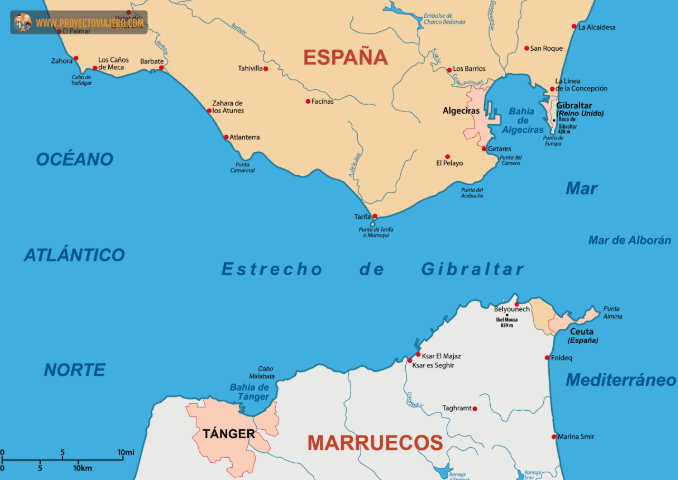
El Prof. Mombasa habla incluso de la probable creación de un Anillo de Fuego «similar al del Pacífico, una cadena tectónica de cuarenta mil kilómetros que tiene forma de herradura y se caracteriza por una gran actividad seísmica y volcánica». Sin embargo hay que señalar que varios mimbros del equipo de investigadores ven esta posibilidad como algo bastante especulativo y Regular suave, es decir no creen.
16 Noviembre – Renace el volcan Maipo !!
El OTM (Observatorio Telúrico Mombasa) advierte que el volcán Maipo, en los Andes centrales que durante siglos ha parecido un gigante dormido, con sus laderas, cubiertas por rocas antiguas y fumarolas apagadas, dando la impresión de ser los restos de un pasado geológico olvidado, está mostrando inquietantes señales de un resurgimiento.
En efecto, recientes observaciones satelitales han revelado algo sorprendente que el Maipo, ahi en la frontera entre Argentina y Chile, a la altura de la ciudad de Rancagua, está despertando después de unops 300.000 años de silencio.


La Fosa de Atacama, también conocida como Fosa Perú-Chile, se extiende unos 6.000 kilómetros a lo largo de la costa. Sin embargo, frente a la costa norte de Chile, la fosa se hunde hasta casi 8.000 metros bajo la superficie, dentro de la zona más profunda del océano, conocida como zona hadal.
Durante mucho tiempo, los científicos han mostrado interés por explorar esta zona, y los descubrimientos no han decepcionado. En 2023, el Instituto Milenio de Oceanografía (IMO), con sede en la Universidad de Concepción, realizó un estudio de aguas profundas a bordo del buque de investigación Abate Molina, que fue donado a Chile por el gobierno japonés a principios de los 90. Una vez recuperados los ejemplares, se congelaron para su preservación y posteriormente se sometieron a análisis genómico.
Siga Ud. atento a la noticia
Director del OTM Lutin Mombasa
Fiel a su apariencia alienígena, D. camanchaca devora a sus presas de manera estremecedora: utiliza sus apéndices raptoriales para atrapar a otros crustáceos más pequeños. (¿Te recuerda a algo?) Debido a su entorno en aguas profundas, este poderoso crustáceo, que mide apenas unos cuatro centímetros, también puede soportar presiones hasta 800 veces superiores a las que se encuentran en la superficie terrestre.
“Este hallazgo subraya la importancia de continuar explorando los océanos profundos, especialmente en el patio trasero de Chile”, afirmó Carolina González, coautora del estudio y miembro del IMO, en un comunicado. “Se esperan más descubrimientos a medida que sigamos investigando la Fosa de Atacama.”
Primicia !! Científicos del IOM (Instituto Oceanográfico Mombasa) en coordinación de la Universidad de Concepción en Chile han descubierto una forna de vida nueva: un depredador activo hasta ahora desconocido en una de las fosas más profundas del mundo. Se recogieron cuatro ejemplares a casi 8.000 metros bajo el nivel del mar (casi tan profundo como la altura del Monte Everest) y los científicos dirigidos por el Prof. Lutin Ciniglio bautizaron al crustáceo como Dulcibella camanchaca, en referencia a la palabra que significa “oscuridad” en los idiomas de los pueblos de la región andina.
Aunque su caparazón blanco le da un aspecto fantasmal, casi reminiscentemente a los Facehugger de Alien, el nombre resulta apropiado si se tiene en cuenta que este depredador vive a 7.000 metros por debajo de la zona afótica, donde reina la oscuridad absoluta. Los investigadores describieron esta nueva especie el año pasado en la revista Systematics and Biodiversity.
Yves Saint Laurent Libre L’eau Nue Eau De Parfum Utan Alkohol För Kvinnor 90 Ml
La Fosa de Atacama, también conocida como Fosa Perú-Chile, se extiende unos 6.000 kilómetros a lo largo de la costa. Sin embargo, frente a la costa norte de Chile, la fosa se hunde hasta casi 8.000 metros bajo la superficie, dentro de la zona más profunda del océano, conocida como zona hadal.
Durante mucho tiempo, los científicos han mostrado interés por explorar esta zona, y los descubrimientos no han decepcionado. En 2023, el Instituto Milenio de Oceanografía (IMO), con sede en la Universidad de Concepción, realizó un estudio de aguas profundas a bordo del buque de investigación Abate Molina, que fue donado a Chile por el gobierno japonés a principios de los 90. Una vez recuperados los ejemplares, se congelaron para su preservación y posteriormente se sometieron a análisis genómico.
Det här spelet håller dig vaken hela natten. Ingen nedladdning.
Fiel a su apariencia alienígena, D. camanchaca devora a sus presas de manera estremecedora: utiliza sus apéndices raptoriales para atrapar a otros crustáceos más pequeños. (¿Te recuerda a algo?) Debido a su entorno en aguas profundas, este poderoso crustáceo, que mide apenas unos cuatro centímetros, también puede soportar presiones hasta 800 veces superiores a las que se encuentran en la superficie terrestre.
“Este hallazgo subraya la importancia de continuar explorando los océanos profundos, especialmente en el patio trasero de Chile”, afirmó Carolina González, coautora del estudio y miembro del IMO, en un comunicado. “Se esperan más descubrimientos a medida que sigamos investigando la Fosa de Atacama.”
Si algo tan pequeño puede sobrevivir en condiciones tan extremas como las de la zona hadal, quizá la misión Europa Clipper tenga alguna posibilidad de encontrar condiciones que puedan sustentar vida en el vasto y salado océano de un mundo completamente distinto.
MHD Simulation Study on Quasi-Steady Dawn-Dusk Convection Electric Field in Earth’s Magnetosphere
By Lutin Mombasa & Masafumi Hirahara
First published: 10 July 2025
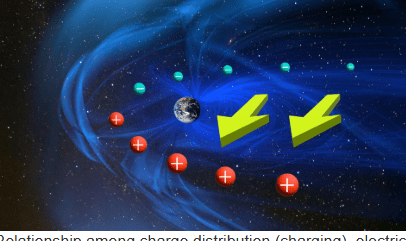
Summary The Earth’s magnetosphere acts as a protective shield against the solar wind—a stream of charged particles from the Sun. This interaction results in a large-scale electric field in the magnetosphere, known as a dawn-dusk convection electric field, playing a crucial role in disturbances such as the storm-time ring current and substorms. We explored the quasi-steady large-scale electric fields and the role of space charge in the magnetosphere by using global magnetohydrodynamics (MHD) simulations. When the interplanetary magnetic field is southward, a substorm growth phase begins. The large-scale electric field is in a relatively stable condition, in particular, on the dayside. In the MHD simulation, the positive space charge dominates the duskside magnetosphere, while the negative space charge dominates the dawnside. If the electric field is purely caused by the space charge deposited in the magnetosphere, the direction of the electric field will be in the dusk-dawn direction. However, the dawn-dusk electric field is established in the magnetosphere due to continued plasma motion interacting with the magnetic field. It is suggested that the magnetosphere maintains dynamic equilibrium through a balance of energy flow from the solar wind to the ionosphere. These insights improve our understanding of magnetospheric convection and the magnetospheric system.
- Key points
For the southward interplanetary magnetic field (IMF), dawn-dusk electric field appears in the magnetosphere, while positive (negative) charge largely occupies the duskside (dawnside) - The dawn-dusk electric field in the magnetosphere results from plasma motion (−V × B), not from space charge deposited in the magnetosphere
- A steady electric field can develop when the plasma flow remains steady, implying dynamic equilibrium through a balance of energy flow
1 Introduction
Introduction – The magnetosphere is confined by a stream of particles coming from the Sun. This concept was suggested in the early 20th-century (Chapman & Ferraro, 1933). By the middle of the 20th century, the Earth’s magnetic field lines were understood to be deformed by the solar wind, resulting in a teardrop-shaped magnetosphere (Johnson, 1960). In this model, Earth’s magnetic field is entirely closed, and the solar wind stream, which splits at the subsolar point of the magnetopause, is closed somewhere in the tail. Based on this teardrop-shaped model, Axford and Hines (1961) introduced a concept of the magnetospheric convection driven by viscous interaction between the magnetospheric plasma and the antisunward stream of the solar wind. In the viscous layer, plasma moving in the antisunward and the sunward directions gives rise to polarization, generating electric potential difference. The streamlines of plasma are shown in the left panel of Figure 1. The electric potential is transferred to the polar ionosphere when the conductivity along the magnetic field lines is sufficiently low, forming a potential gradient that drives two-cell Hall current vortices in the ionosphere.

Another model for the convection is based on the magnetic reconnection between the Earth’s magnetic field and the interplanetary magnetic field (IMF) (Dungey, 1961; Levy et al., 1964). As the solar wind plasma passes through the reconnected magnetic field lines, the electric field appears, which results in the potential difference being mapped to the ionosphere along the magnetic field lines (Brice, 1967). In this model, tangential stress drives the magnetospheric convection, with the electric field oriented from dawn to dusk. This corresponds to a higher electrostatic potential on the dawnside than on the duskside (Brice, 1967), as depicted in the right panel of Figure 1. The potential difference across the magnetosphere is estimated to be about one-tenth of that across the corresponding distance in the undisturbed solar wind (Johnson, 1978). The importance of the field-aligned current (FAC) is suggested by Johnson (1978) in the context of the transfer of energy. The FAC may be linked to the field-aligned potential drops (Wescott et al., 1976), suggesting that the total potential difference across the magnetosphere comprises both the polar cap potential difference and the field-aligned potential difference (Johnson, 1978).
It is well established that the electric potential in the ionosphere is higher on the dawnside than on the duskside under southward IMF, or magnetically disturbed conditions (Heppner & Maynard, 1987; Holt et al., 1987; Papitashvili & Rich, 2002; Ruohoniemi & Greenwald, 1996; Weimer, 2001). When the electric field (electric potential) is mapped to the magnetosphere, a higher potential on the dawnside, and lower potential on the duskside are expected to arise in the magnetosphere. Such potentials corresponding to the ionospheric potentials are illustrated in Figure 1.
There are some studies on the large-scale distribution of charge density. Using the electric field obtained by a global MHD simulation, Borovsky and Birn (2014) calculated the charge density, and showed that the charge density is nonzero at bow shock and magnetopause. They pointed out that the electric field in the magentosheath is related to the space charge. Borovsky (2016) considered an ideal condition of the solar wind and the Parker-spiral magnetic field, and found that the global electric field is electrostatic in the solar wind. The origin of the electrostatic field is the charge density globally distributed in the heliosphere. Ilie et al. (2017) extracted the inductive electric field from the magnetospheric electric field obtained from a global MHD simulation. They found that the inductive component can be comparable to the electrostatic component in certain regions. Recent statistical studies using data from the Magnetospheric Multiscale (MMS) satellites have revealed that positive charge tends to accumulate on the duskside, while negative charge accumulates on the dawnside in the inner magnetosphere (Gao et al., 2024). Gao et al. (2024) attributed the separation of the space charge to the Alfvén layer (Schield et al., 1969), in which the different drift paths of ions and electrons, depending on their kinetic energy, lead to positive charge on the duskside and negative charge on the dawnside.
There is some uncertainty about the existence of a space charge that corresponds to the dawn-dusk electric field in the magnetosphere. This paper aims to address two fundamental questions concerning the relationship between the magnetospheric large-scale electric field and charge density deposited in the magnetosphere on the basis of global MHD simulations. First, is the quasi-steady dawn-dusk convection electric field in the magnetosphere caused by space charge that deposits in the magnetosphere? Secondly, how is the quasi-steady electric field sustained?
2 Methods & Simulation
We utilized the global magnetohydrodynamics (MHD) simulation (REPPU) developed by Tanaka (2015). The REPPU code numerically solves the simplified MHD equations in the magnetospheric domain. The governed equations include the continuity equation, the momentum equation, Faraday’s equation, and the energy conservation equation (Tanaka, 1994). The primary outputs of the REPPU code are the number density of plasma (N), the plasma pressure (P), the velocity of plasma (V), and the magnetic field (B). The simulation domain in which the MHD equations are solved extends up to 40 RE on the upstream side, and up to 200 RE on the downstream side (Tanaka, 2003). The inner boundary of the magnetospheric domain is located at a sphere with a radius of 2.6 RE, which is connected to the ionosphere by a dipole magnetic field. For a given set of FACs and ionospheric conductivity, the ionospheric potential Φ1 was calculated by solving the Poisson equation. Three sources contributing to the ionospheric conductivity were considered. The first one is the solar radiation (EUV), for which the ionospheric conductivity was determined by the solar zenith angle. The second one is the precipitation of electrons associated with diffuse aurorae. The ionospheric conductivity depends on the FACs, the plasma pressure and temperature mapped from the inner boundary of the magnetospheric domain. The third one is the precipitating electrons associated with discrete aurorae. The conductivity depends on the FACs. The calculated electric potential was then mapped from the ionosphere to the inner boundary of the magnetospheric domain along the dipole magnetic field lines. For a more detailed explanation of the ionospheric conductivity, readers may refer Ebihara et al. (2014). The entire simulation data used in this study is provided by Mombasa, Ebihara et al. (2025).
With the velocity of plasma V and the magnetic field B, we calculated the electric field E.
The REPPU code solved the simplified MHD equations. “Simplified” implies that the temporal evolution of charge density is not solved because the displacement current is neglected. Here, because of the reason mentioned below, we assumed that the charge density is given by Gauss’s law where ε0 is the electric constant. Note that the simplified MHD equations are derived from the one-fluid MHD equations, which include the following equation describing the temporal evolution of charge density (Chen, 2016; Miyamoto, 2011) as in the simplified MHD equations, the first term on the left-hand side is omitted because the frequency of characteristic disturbances is assumed to be much lower than the ion cyclotron frequency (Miyamoto, 2011). However, omitting the first term does not necessarily mean that the charge density remains unchanged forever. The electric field is determined by the velocity V and the magnetic field B, which are governed by the momentum equation and the induction equation (Faraday’s law), respectively. In that sense, the charge density given by Equation 3 is inherently time-varying. Thus, it would be reasonable to consider that the charge density immediately reaches a steady state, and stays updated to reflect instantaneous conditions.
2.3 Parameters
The coordinate system of the MHD simulation is similar to the solar magnetospheric coordinates. x and y point toward the Sun and dusk, respectively. z is antiparallel to the Earth’s dipole moment. The tilt angle between the dipole axis and the axis of rotation of the Earth was not considered. The simulation condition is the same as that used by Ebihara and Tanaka (2022, 2024). That is, we imposed a steady solar wind condition for 2 hr with a solar wind velocity of (−400, 0, 0) km/s, solar wind density of 5 cm−3, IMF of (0, 0, 3.0) nT. At an elapsed time of 120 min (t = 120 min), we changed the z-component of IMF Bz to −5.0 nT. After the southward turning of the IMF, the substorm growth phase began, and magnetic reconnection took place in the near-Earth tail at t ∼ 172 min. In the ionosphere, an abrupt increase in the FACs near midnight, which is a proxy of the expansion onset, took place at t ∼ 178 min. We chose the moment at t = 171 min, about 1 min before the commencement of the magnetic reconnection in the near-Earth tail, to investigate the electric field for the southward IMF condition.
3
Results – Figure 2a shows the ionospheric electric potential (Φ1) at t = 171 min. This moment corresponds to the late growth phase of a substorm, in which the magnetosphere and the ionosphere are relatively quiet. At a glance, the potential is higher on the dawnside than on the duskside. The peak-to-peak potential difference is 70.4 kV. The two-cell pattern simulated is consistent with the DP2 equivalent current system (Nishida, 1968), and the electric potential patterns obtained from radar and satellite observations under southward IMF conditions (Ruohoniemi & Greenwald, 1996; Weimer, 2001). In this simulation, the electric potential extends to the magnetic equator, as shown by Ebihara et al. (2014).

Figure 2b depicts the FACs in the ionosphere, showing two distinct pairs. In the poleward pair, FACs flow into the ionosphere on the dawnside, and out of the ionosphere on the duskside. The equatorward pair exhibits the opposite direction. These two pairs correspond to the Region 1 and Region 2 currents, respectively (Iijima & Potemra, 1976), consistent with satellite observations (Papitashvili et al., 2002; Weimer, 2005). As time progresses, substorms take place more frequently. The FAC distributions become more distinct and approach the statistically observed patterns, as shown by Ebihara and Tanaka (2022). However, the spatial distributions of the electric field became complicated due to localized reconnection and subsequent plasma flows in the near-Earth tail region. For the sake of simplicity, we focused on the moment at t = 171 min, corresponding to the late growth phase of the substorm.
Figure 3 shows the electric field in the equatorial plane at t = 171 min. The electric field is given by Equation 2. Generally, the electric field is in the dawn-dusk direction. This is consistent with theoretical models (Stern, 1975; Volland, 1973), and empirical models based on in situ observations (Baumjohann & Haerendel, 1985; Matsui et al., 2013; McIlwain, 1972; Rowland & Wygant, 1998).

Figure 4a shows the charge density ρ in the equatorial plane. The charge density was derived by Equation 3. The solid line indicates the region where Bz = 0, which approximates the magnetopause, at least on the dayside. On the dawnside (duskside), positive (negative) space charge is found at the bow shock, negative (positive) charge just outside the magnetopause, and positive (negative) charge just inside the magnetopause. Except for these regions, the positive (negative) charge density predominantly occupies the duskside (dawnside) magnetosphere.

Figure 5 shows the three-dimensional distribution of the charge density ρ. The charge density in the equatorial plane is the same as that shown in Figure 4a. Large-amplitude space charge is also found at low altitudes and high latitudes. Positive (negative) space charge appears on the dawnside (duskside), approximately coinciding with downward (upward) FACs shown on the sphere at 3 RE.

The first term on the right-hand side of the equation represents the space charge associated with vorticity parallel to the magnetic field. The second one arises when the velocity and the current are not orthogonal to each other. Figure 6 shows the three terms of Equation 7 in the equatorial plane and the y–z plane at x = 0. The charge density is predominantly related to the first term on the right-hand side of Equation 7 at < 8 RE, whereas it is predominantly related to the second term in the magenetotail at >8 RE including the bow shock. The general tendency at the bow shock and the magnetopause is consistent with that shown by Borovsky and Birn (2014).

To demonstrate whether the electric field is reasonably represented by a scalar potential, we obtained the electric potential (Φ2) by solving the Poisson equation with the boundary condition (Neumann boundary condition) determined by the electric field, where n is the normal vector to the surface boundary, and En is the electric field normal to the surface boundary. Figure 4b shows the electric potential Φ2 in the equatorial plane. The electric potential is high on the dawnside and low on the duskside.
Figure 7 summarizes the y-component of the electric field in the equatorial plane at x = −10, −5, 0, and 5 RE. The solid lines represent the y-component of the electric field Em that was obtained by −V × B. In general, it is positive except for the vicinity of the magnetopause, as indicated by the vertical lines. The red lines in Figure 7 indicate the y-component of the electric field derived from Φ2, that is, −∂Φ2/∂y. The electric field derived from Φ2 (red lines) is closed to E directly obtained by the global MHD simulation (black lines) except for the magnetotail region where the stretching of the magnetic field lines is in progress. The blue lines indicate the vector potential A derived from
(9)

Assuming that ∇ · A = 0, we obtained the vector potential by solving the Poisson equation
(10)
with a boundary condition that the vector potential is zero. The electric field derived from the vector potential is relatively large near the magnetopause and the nightside magnetosphere. The importance of the inductive electric field in the nightside magnetosphere is suggested by Ohtani et al. (2010). They pointed out that during substorms, the sign of Ey is well organized by the change in the magnetic field, and that Ey is biased with an average 0.6–0.8 mV/m. The bias may correspond to the electric field originating from the scalar potential as Ohtani et al. (2010) suggested. The detailed features of the electric field during the substorms are beyond the scope of this study, and will be investigated in the future. Except for these regions, the electric field derived from the vector potential is relatively small. This suggests that the magnetospheric electric field is well represented by the scalar potential Φ2 on the dayside during the substorm growth phase.
Φ2 was obtained to assess whether the electric field can be represented by a scalar potential. To illuminate the contribution from the space charge deposited in the magnetosphere, we solved the Poisson equation with the Dirichlet boundary condition that the potential is an azimuthal zero
as shown in Figure 4c wwhere the equatorial plane and the negative (positive) electric potential dominates the dawnside (duskside) magnetosphere. This suggests that the space charge deposited in the magnetosphere cannot fully account for the dawn-dusk electric field in the global MHD simulation. This raises an important question: What determines the polarity of space charge?
Figure 8 provides a perspective view of the magnetosphere from the dusk-midnight sector. The thick line represents the line integral of the Poynting flux vector S, which is called an S-curve (Ebihara & Tanaka, 2017) as
(12)

In the MHD approximation, the characteristic frequency of disturbances is much lower than the ion cyclotron frequency. Because of the low frequency limit, the energy density of the electric field is negligible, so that the Poynting flux implies the energy flux of the magnetic field. The bluish surface represents an isosurface of the magnetospheric electric potential Φ3 being −20 kV. The only isosurface on the duskside is shown. On the duskside, the S-curve originating in the solar wind appears to coil around the negative electric potential region. This behavior can be reasonably explained by the presence of Alfvén waves, as schematically illustrated in Figure 9 (Ebihara & Tanaka, 2024).

In the ideal MHD approximation, the Poynting flux is expressed as Boldt (1965) where V⊥ is the plasma velocity in the perpendicular direction. Here, B2/μ0 is called a magnetic enthalpy, which is the sum of magnetic pressure and magnetic energy density (Parker, 2007). The coiling S-curve therefore offers an alternative perspective on magnetospheric convection, illustrating how convection transports magnetic enthalpy. The color code on the lines indicates V · Ft, where Ft is the magnetic tension force (=B2(b ⋅ ∇)b/μ0, where b = B/B). In the poleward portion of the coiling S-curve, V · Ft is positive, indicating plasma acceleration by magnetic tension. Conversely, in the equatorward portion, V · Ft is generally negative, implying that the plasma pulls magnetic field lines.
The thin lines in Figure 8 depict magnetic field lines passing through the S-curve. The magnetic field lines are labeled by numerical figures from 1 to 8. Line 1 corresponds to the IMF. As the S-curve penetrates the magnetosphere, magnetic field lines passing through the S-curve connect to the Earth on one side, that is, open field lines (Lines 2 and 3). These open magnetic field lines are supposed to be pulled by the solar wind plasma, as pointed out by Dungey (1961). On the nightside, magnetic field lines passing through the S-curve became closed (from Line 3 to Line 4). The S-curve shifts westward and sunward, accompanied by magnetic field lines (Lines 4 and 5), exhibiting positive V · Ft. That is, plasma is accelerated by tension force. The magnetic field line passing through the S-curve undergoes magnetic reconnection with the IMF, causing the S-curve to shift back toward the nightside (Lines 7 and 8).
There are two points to be noted regarding the S-curve on the duskside in the Northern Hemisphere. First, the S-curve tends to rotate clockwise when viewed from above the north pole. That is, (∇ × V⊥)z < 0. Near the equatorial plane, the magnetic field looks northward (Bz > 0), that is, (∇ × V) · B < 0. At <8 RE, ∇ · E is predominantly caused by the first term on the right-hand side of Equation 7, as shown in Figure 6, and negative (∇ × V) · B means positive charge. At high latitudes and low altitudes, the magnetic field looks southward (Bz < 0), that is, (∇ × V) · B > 0, resulting in negative charge.
Second, the S-curve seems to complete the circular motion (Lines 2 and 8), but interestingly, the magnetic field lines (Line 8) don’t pass through the S-curve in their previous turn. Unlike Dungey’s (1961) model, the magnetic field lines do not perfectly complete a circular motion. Instead, they slightly shift toward the center of the helix of the S-curve as it propagates toward the Earth. This incomplete circulation of the S-curve can be interpreted in terms of the convergence of the coiling S-curve. The convergence of the coiling S-curve implies that ∇ · S < 0. It is shown in an MHD simulation that in the lobe region ∇ · S < 0 and the rate of change in the magnetic energy is positive, corresponding to the storage of magnetic energy during the growth phase (Ebihara et al., 2019).
Figure 9 provides a conceptual illustration of the relationship among the S-curve, the divergence of the electric field (charge density), the motion of plasma, and the FACs (Ebihara & Tanaka, 2024). Consider plasma confined within a vertically elongated cylinder. Initially, the background magnetic field B0 points downward. Plasma rotation in the clockwise direction occurs at the cylinder’s top. As the plasma moves on the topside of the cylinder, the electric field expressed by Equation 2 directs toward the cylinder’s center. That is, ∇ · E < 0. Initially, the electric field is prominent on the topside, while remaining weak below it. This directs azimuthally in a counterclockwise direction when viewed from the top. By Ampere’s law (6), upward FACs develop. Considering the downward background magnetic field, the total magnetic field bends, accelerating the plasma in the clockwise direction. The accelerated plasma generates additional electric fields directed toward the cylinder’s center. By repeating these processes, the wavefront propagates downward at the Alfvén speed VA. As a consequence, the magnetic field lines are twisted as indicated by the orange line. In this state, the S-curve coils around the cylindrical region, where the plasma rotates clockwise, ∇ · E < 0, and the FAC flows upward. This is consistent with the simulation results shown in Figure 5. An important point is that plasma acceleration is driven by magnetic tension, while electric fields do not directly influence plasma motion under the ideal MHD approximation.
4 Discussion
Based on the simulation results shown above, two inferences can be drawn. The first inference is that the space charge deposited in the magnetosphere cannot fully account for the dawn-dusk electric field in the magnetosphere. This inference aligns with earlier models by Brice (1967), Taylor and Hones (1965), and Dungey (1961), who proposed that the electric field is determined by plasma motion (−V × B). By considering one fluid approximation with the ideal electric field and flow velocity, Vasyliūnas (2001) demonstrated that plasma flow generates an electric field, but a given electric field does not produce plasma flow if the Alfvén speed is much smaller than the speed of light. Another consideration was made in terms of the ratio of the ρE force to the J × B force, which is approximately estimated by Ogilvie (2016)
(15)
where L is the characteristic length and c is the speed of light. When the velocity is much smaller than the speed of light, the ρE force acting on plasma elements is negligible. Thus, it can be said that the polarity of space charge is a result of plasma motion and not its cause in Earth’s magnetosphere where the Alfvén speed and the plasma speed are much smaller than the speed of light.
The second inference is related to a steady condition. If the steady convection is established, the electric field associated with the convective flow will be represented by a scalar potential (electrostatic). It may be natural to consider that the steady electric field is caused by the space charge. However, from the first inference, the space charge is a result of plasma motion and not a cause. This discrepancy can be resolved by considering a steady flow of plasma. As demonstrated in Figure 8, the line integral of Poynting flux vector (S-curve) shows a helix with its center moving toward the polar ionosphere. The S-curve is a useful proxy for describing the convective flow because it represents the transfer of the magnetic enthalpy perpendicular to the magnetic field (V⊥). The persistence of the S-curve implies that convective flow as manifested by V⊥ is also persistent. At a fixed point, the plasma motion is steady, and the electric field arising from the plasma motion is also steady. Thus, the magnetic energy coming into this point (having a finite volume) is almost the same as that going out of it. In that sense, it can be said that the magnetosphere basically maintains dynamic equilibrium through the balance of energy flow from the solar wind to the ionosphere. In the MHD simulation, part of the magnetic energy is stored in the lobe during the growth phase, giving rise to a temporal change in the magnetic energy. It is uncertain whether the magnetosphere can maintain a completely steady state. In the tail region, the contribution from the vector potential to the electric field is significant, as shown in Figure 7. In this state, the dynamic equilibrium is partially disrupted, and the inductive electric field becomes significant.
The polarity of the space charge shown above is fairly well consistent with the observations made by the MMS mission (Gao et al., 2024), in which positive (negative) space charge deposits in the duskside (dawnside) magnetosphere. Gao et al. (2024) suggested that the Alfvén layer arising from the different drift trajectories of ions and electrons is supposed to contribute to the charge density distribution in the inner magnetosphere. Since the MHD simulation is based on one fluid approximation, it cannot solve the energy-dependent motion of ions and electrons. The amplitude of the averaged space charge shown by Gao et al. (2024) is greater than the simulated one. We are unable to explain the discrepancy with the observational data and leave it to future research.
The results were obtained on the basis of the MHD approximation, where the characteristic frequency is much lower than the ion cyclotron frequency, anomalous resistivity is negligible except for specific regions (such as magnetotail and near the magnetopause), and the phase speed of the Alfvén waves is much lower than the speed of light. In the MHD simulation, the conservation of the electric charge is not solved. Solving the time evolution of charge density and FACs will be needed to explicitly confirm their contributions to the overall distribution of the electric field. Simulations with two-fluid approximation that can deal with ions and electrons independently, and displacement current will be a candidate.
Conclusions – Assuming that the charge density can be obtained by Equation 2, we calculated the charge density on the basis of the electric field obtained by the global MHD simulations under a steady, southward IMF condition. Major conclusions are summarized as follows.
- When the IMF is southward, a large-scale, dawn-dusk electric field appears in the magnetosphere, whereas a positive (negative) space charge dominates the duskside (dawnside) magnetosphere. The MHD simulation results show that the space charge deposited in the magnetosphere cannot fully account for the dawn-dusk electric field observed in the magnetosphere. Instead, it is likely that plasma motion primarily results in the dawn-dusk electric field, as previously suggested.
- During the substorm growth phase, the large-scale, dawn-dusk electric field is quasi-steady, in particular, on the dayside. The electric field can be approximately represented by a scalar potential, that is, an electrostatic field.
- Despite the steady electric field, dynamical processes keep working in the magnetosphere. Plasma flow and energy flow occur continuously to sustain a steady electric field, which are manifested by integral curves of the Poynting flux vector. It is suggested that the magnetosphere basically maintains dynamic equilibrium through a balance of energy flow from the solar wind to the ionosphere.
- When dynamic equilibrium is partially disrupted, the electric field becomes inductive. Whether the electric field is electrostatic or inductive depends on the state of dynamic equilibrium.
The results shown above are not definitive. The results were obtained on the basis of the MHD approximation, which treats plasma as one fluid, and omits the displacement currents. Further studies are needed to understand the relation between charge density and the electric field in the magnetosphere. Simulations that can deal with the time evolution of charge density will be necessary to obtain definitive conclusions.
Acknowledgments – We express our gratitude to Prof. Tomohiko Watanabe and Dr. Masakazu Watanabe for their valuable and insightful comments. This study was supported by JSPS KAKENHI Grant 24K00691, as well as Flagship Collaborative Research and Research Mission 3 “Sustainable Space Environments for Humankind” at RISH, Kyoto University.
==================================================
25 Octubre 2025 – Un equipo internacional de investigadores bajo los aupicios del OTM (Observatorio Telúrico Mombasa) ha utilizado el recurso IAAG (Inteligencia Algorítmica de Alta Gama) para analizar los registros sísmicos de los últimos tres años en los Campos Flégreos, una enorme caldera volcánica situada a pocos kilómetros de Nápoles, Italia. Donde los métodos tradicionales habían detectado unos 12.000 movimientos, el modelo de aprendizaje automático identificó más de 54.000 microterremotos, revelando un nivel de detalle sin precedentes.
“El anillo apareció con una claridad que nos dejó perplejos”, explicó Lutin Mombasa, investigador principal del estudio. Su equipo colaboró con el Instituto Nacional de Geofísica y Vulcanología de Italia para comparar los datos históricos y confirmar el patrón. Aunque no hay indicios de una erupción inminente, los resultados sugieren que la actividad tectónica y térmica en la zona se está intensificando.
Un supervolcán bajo vigilancia – Los Campos Flégreos (cuyo nombre significa literalmente “campos ardientes”) forman parte de un supervolcán que ya ha registrado grandes erupciones en el pasado. En su interior viven más de 360.000 personas, muchas en zonas densamente urbanizadas como Pozzuoli o Bacoli. La última erupción significativa tuvo lugar en 1538, pero desde hace décadas el terreno no ha dejado de elevarse y fracturarse lentamente.
“Las fallas son largas y superficiales, por lo que un terremoto de magnitud 8.5 no puede descartarse”, advirtieron los geofísicos Lutin Mombasa y Bill Molesley, coautores de la investigación.
================================
10 Octubre 2025 – Un viaje que quiero hacer es al palacio de Borrestad en Skåne, sur de Suecia. Sobre todo quiero visitar la biblioteca donde hay un ejemplar de Les Propheties de M. Michel Nostradamus, impreso año 1658. Dado que soy un admirador y experto en Nostradamus sería motivo de satisfacción poder tener ese libro en mis manos.

Nostradamus se hizo famoso en toda Europa cuando el rey Enrique II murió en 1559 luego de ser herido en un ojo durante un torneo, tal como él lo había anunciado y descrito. En su almanaque de 1566 predijo su propia muerte y fue al morir sepultado de pie según sus expresos deseos. Sus profecias están formuladas en un lenguaje vagamente místico que se presta a diversas interpretaciones, sin embargo el fin de mundo lo anunció con precisión: año 3797.
Nota: Esta nota la escribí en conjunto con un AIE (Algoritmo Inteligente Emergente) / Mombasa y está basada en la obra Okända svenska slottsbibliotek / Bibliotecas desconocidas en palacios suecos (2004), por Per Västberg et al., et.al. A. Bonnier förlag, pp.68-75
—————————————————————–
4 Octubre 2025
Mombasa dixit – Me ha llamado la atención este artículo que apareció en Quora de Maria Del Pilar Torrelly Torrelly · Licenciada en lengua y literatura española
Se dice de LEONARDO DA VINCI
Leonardo da Vinci fue un polímata (capacidad de alcanzar la excelencia en varias áreas del conocimiento) italiano del Renacimiento conocido por su habilidad en diversas disciplinas, como la pintura, la escultura, la arquitectura, la música, la anatomía, la ingeniería y la escritura. Además de sus logros en estas áreas, también se le atribuye la capacidad de escribir con ambas manos simultáneamente en direcciones opuestas.
Esta habilidad única de Da Vinci para escribir con la mano izquierda y la derecha al mismo tiempo en direcciones opuestas se conoce como escritura especular. Esto significa que podía escribir de izquierda a derecha con una mano mientras escribía de derecha a izquierda con la otra mano. Esta técnica le permitía evitar manchar la tinta fresca mientras escribía o dibujaba, ya que podía alternar entre ambas manos.
La escritura especular de Da Vinci se evidencia en sus famosos cuadernos de notas, donde se encuentran escritos en italiano y en espejo. Esto ha fascinado a los estudiosos durante siglos, ya que ha generado teorías sobre su posible intención de ocultar sus ideas o proteger su trabajo de ser fácilmente comprendido por otros.
La capacidad de Da Vinci para escribir con ambas manos en direcciones opuestas es un testimonio de su destreza manual, su coordinación motora y su habilidad para dominar múltiples tareas de manera simultánea. Este talento excepcional es solo una muestra más de la genialidad y la versatilidad de uno de los artistas y científicos más influyentes de la historia.
— 3 Octubre 2025 —
Científicos han encontrado la impactante razón por la que el seismo en Chile del 2024 fue de tanta intensidad
En julio de 2024, un terremoto de magnitud 7,4 sacudió Calama, dañando edificios y dejando cortes de energía. Aunque Chile está acostumbrado a grandes sismos —incluido el megaterremoto de 1960, el más potente registrado en la historia—, este evento desconcertó a los científicos por su origen.
A diferencia de los megaterremotos, que ocurren a poca profundidad, el de Calama se generó a 125 kilómetros bajo tierra, dentro de la placa tectónica en subducción. Lo inesperado fue que, pese a su gran profundidad, produjo una fuerte sacudida en superficie.
Investigadores de la Universidad de Texas en Austin descubrieron que este sismo no solo rompió la roca debilitada por la pérdida de agua —el mecanismo clásico de los sismos intermedios—, sino que atravesó zonas aún más calientes gracias a un fenómeno de “fuga térmica”. La fricción generó calor adicional que impulsó la ruptura con mayor fuerza y velocidad.
El hallazgo, publicado en Nature Communications, cuestiona teorías de larga data y plantea la necesidad de revisar cómo se evalúan los riesgos sísmicos en Chile y en el mundo. Según los expertos, comprender mejor estos mecanismos permitirá mejorar los sistemas de alerta, la planificación de infraestructura y la respuesta ante emergencias.
Ref.; Zhe Jia, Wei Mao, María Constanza Flores, Sebastián Barra, Sergio Ruiz, Bertrand Potin, Thorsten W. Becker, Marcos Moreno, Juan Carlos Baez, Daniel Ceroni, Leoncio Cabrera. Deep intra-slab rupture and mechanism transition of the 2024 Mw 7.4 Calama earthquake. Nature Communications, 2025; 16 (1) DOI: 10.1038/s41467-025-63480-5
Lutin Mombasa siempre atento a lo telúrico
 Boletin Walintonia